For one whole summer in London, I was the guy with the clipboard.
You know the one. Big smile. Charity tabard. "Got a minute?" I stopped strangers in the street and asked them for money, all day, every day, for an entire summer. I got told no hundreds of times a day. Some people were lovely. Some people walked straight through me like I was a ghost.
Turns out it was the best training I ever had.
Because twenty-odd careers, four failed businesses and one very late ADHD diagnosis later, I've been told no by pretty much everyone. And I'm still here.
I'm Ross Macfarlane. I'm 42. And this is what happened when I refused to quit.
Twenty careers and counting
Let me give you the highlights reel.
Chef. Travel consultant. Estate agent. Inventory clerk. Fruit picker. Call centres. Sales. Customer service. Street fundraiser. You name it, I've probably done it, got brilliant at the exciting bit, then got bored and moved on to the next shiny thing.
Then I found design, and something finally stuck. I've spent the last 14 years designing apps for a living. I lived in London for years, and now I'm two years into life in Barcelona.
Along the way I started four businesses. All four failed.
For most of my life I thought I was just a bit rubbish at sticking at things. Restless. Scatty. A starter, not a finisher.
Then, at 39, I found out why.
The diagnosis I didn't want
I'd love to tell you it was a relief. That a doctor said "ADHD" and everything suddenly made sense and I floated out of the room on a cloud of self-understanding.
It wasn't. I hated it.
I hated the word. I hated the label. I spent about a year arguing with it, mostly with myself. I tried the medication, didn't like how it made me feel or the anxiety that came with it, and stopped. That's my story, not a prescription. Meds are life-changing for loads of people, and that's a chat for you and your doctor, not me and my blog.
But somewhere in that year, something shifted.
I don't see my ADHD as a disability. Hell, I didn't even know I had it for 39 years. It's just something I've got, and something I have to work with. These are the cards I've been dealt. So fuck it. You push through, you keep trying, and you build the things that make life easier, so you can get on with the stuff you've always dreamed of doing.
And by then, I'd already started building one of those things.
A notepad, a YouTube video and a very dangerous idea
Rewind to 2021. I was running a startup on my own called Cookt, an AI cook-along app (the chef years came in handy). Solo founder life is a special kind of chaos. You're the CEO, the designer, the marketing team and the person who forgot to eat lunch. Every day I'd make a beautiful plan, then spend six hours on whatever was shiniest and zero minutes on what actually mattered.
Sound familiar? Thought so.
The fix came from two very unglamorous places. A time blocking notepad I bought on Etsy, and a YouTube video about seeing your tasks as time.
The rules were stupidly simple. Give every task a block of time. Work on it until the time's up. Then move on, because the clock says so, not because you feel like it. Anything unfinished rolls to tomorrow. Repeat.
It worked. Not "huh, that's nice" worked. My-whole-week-changed worked.
And here's the dangerous bit. Designing apps was my actual job. So a little voice said: you could build this properly.
I went hunting for an app that already did it. The closest was Timebloc, which had a gorgeous way of adding a task by the hour. But no lists. No focus timer. And that's the whole trick. Get it out of your head into a list. Give it a slot in your day. Focus on it. Repeat. Split those across three apps and the system collapses the first time your brain wanders off to look at something shiny. Which, if you're anything like me, is roughly every eleven minutes.
Nobody had built it, not the way I wanted. So I did.
£20k, five months and a plot twist
I'd been dreaming for years about building an app of my own that genuinely helped people. Not a few. Millions. People like me.
So I threw every penny of my savings at it. About £20,000. Five months later the first version of Yoodoo was out. My third app, after four businesses that went bust.
Here's a fun fact: around 99% of apps go nowhere. Crickets. Tumbleweed. Your mum downloads it out of pity.
Yoodoo didn't. Hundreds of people downloaded it and paid for it, fast. I genuinely didn't know what to do with myself.
Then the messages started, with a pattern I did not see coming. Person after person said the same thing: "I've got ADHD. I've tried every planner going. This is the first one that's ever worked for me."
That's what pushed me to get my own diagnosis. And once I had it, Yoodoo stopped being a side project. It became the thing my own brain had been begging for, built for everyone else's too.
The bit nobody sees
Over the next few years I put another £60,000 into Yoodoo.
Read that again. Sixty grand. On top of the twenty.
I had brilliant developers building proper native apps for iPhone and Android, and I kept pushing. Closer. Closer. Just one more feature and it'll be the app in my head. I was obsessed, and obsession is a terrible business plan. It cost me time, money I didn't have, sleep, and very nearly the lot. All of it around a day job and, you know, life.
Yoodoo was downloaded around 100,000 times. And with 100,000 people comes the internet.
People slated it. It was rubbish. It crashed. Why wasn't it free? On Reddit and in reviews, people said I was just some guy profiting off ADHD.
Mate. I've got it. I'm trying to help.
And for the record, the free version is crazily generous, and around 60% of the people who use Yoodoo never pay a penny. The ones who do are what keep the lights on.
But here's what kept me going. For every person slating it, there was someone messaging me privately. People who loved it enough to put up with the bugs. People who said they believed in me, believed in the product, and knew it would be a success one day.
Strangers. Believing in me. That still gets me every time.
March. The really shitty message.
Then, in March this year, I ran out. Out of money, out of steam, burnt out.
Someone emailed me, like people did every other day, to say they loved Yoodoo. It was nearly perfect, they said. Could it just work on a laptop?
And I had to write back: "I'm really sorry. I've run out of money, and I've run out of steam. I'll come back to it if the technology ever catches up."
Then I closed the laptop, and I walked away.
Nearly five years. £80,000. One very stubborn idea. Done.
Except it wasn't.
Six months off. (I lasted about a week.)
Six months off, I told myself. Rest. Recover. Touch grass.
Reader, I did not touch grass.
Within weeks I'd started two new startups. Sticky Spanish, a language app that's on the App Store right now, and The Daily Cortado, a daily email. Plus a pile of side projects with friends, because apparently "time off" means something different in my head. And yes, like a true ADHD'er, I got most of them to the exciting bit and wandered off.
But something weird kept happening while I built them.
Stuff that used to take my developers weeks, I was doing in an afternoon. On my own. With AI writing the code while I designed, decided and poked at everything until it felt right. Not "write me a poem about a cat" AI. Actually-ship-a-real-app AI.
And one night, halfway through yet another side hustle, the penny dropped.
Hang on. If I can build these on my own... could I go back to Yoodoo?
I opened Figma. Dug out my old designs. Then I closed them, and started a brand new file from scratch.
Only this time I wasn't guessing. I had years of feedback, reviews, data and hundreds of messages living rent-free in my head. I knew exactly where the old Yoodoo had let people down, where it had let me down, and which holes it had never quite filled. So I filled them. One screen at a time.
I'm not an engineer. I've got basic coding skills at best. But I've spent 14 years knowing exactly how an app should look, feel and behave, down to the millisecond a button takes to respond. What I'd always been missing was a team big enough to build it as fast as I could design it.
Now I had one. So I got the code back from my developers, sat down with AI as my build partner, and did something completely unhinged.
I started again. From nothing.
Four weeks, 1,186 changes and a lot of 18 hour days
AI did the heavy lifting on the code. I did what I'm actually good at: deciding what every screen does, how every tap feels, what to cut, and saying "no, that's wrong, again" approximately four thousand times. Every decision, every word and every pixel still went through me.
Four weeks later, the new Yoodoo was live.
1,186 changes. More 18 hour days than I'd like to admit to my GP. Was it healthy? Absolutely not. Was it the most fun I've had in years? Absolutely yes.
So what actually is Yoodoo?
If you're new here: Yoodoo is a daily planner for people whose days go sideways. Built for ADHD brains, works for everyone. It helps you get everything out of your head, make a day that's actually realistic, start, and get back on track when it all goes wrong.
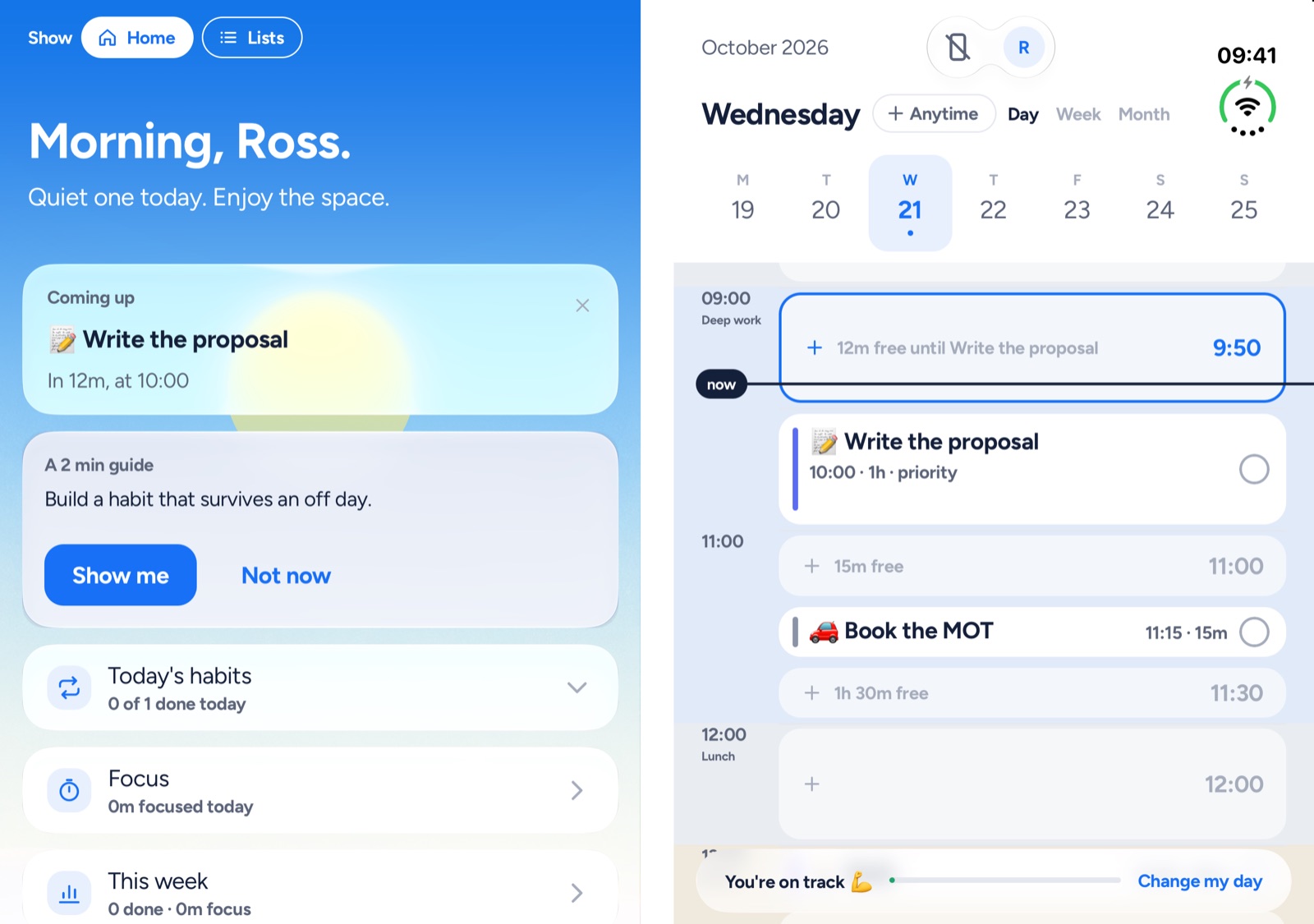
- A timeline where an hour actually looks like an hour. You see your day, the gaps, and how long things really take. Time blindness doesn't stand a chance.
- Fix my day. Your plan is going to break. That's not the problem. Not knowing how to get back on track is. One tap and Yoodoo moves everything around the stuff that can't move, protects the one thing that matters most, and rolls whatever doesn't fit to later. Nothing piles up. Nothing turns red. Nobody shames you.
- Ask Yoodoo. Tell it what's going on, typed or out loud. "Dentist at 2, need to do the tax return, gym if I'm alive." It builds your day, moves stuff, and breaks big scary things into steps.
- A brand new homepage. The sky behind it follows the real time of day. It tells you how long you've got until your next thing. And it only ever shows you one thing at a time, because your brain has enough tabs open already.
- Lists, focus and habits, finally joined up. List it, drop it on your day, hit focus, done. Build habits that survive an off day.
- A phone blocker for the apps that steal your day, on a schedule or right now, with a few timed unblocks so it never feels like prison.
- Desktop and web. The thing people asked for most. Open app.yoodoo.app and it's synced with your phone.
- Widgets, Live Activities and the iPhone Duo. Your day on your Home Screen, your focus timer on your Lock Screen, and a layout built for Apple's new folding iPhone.
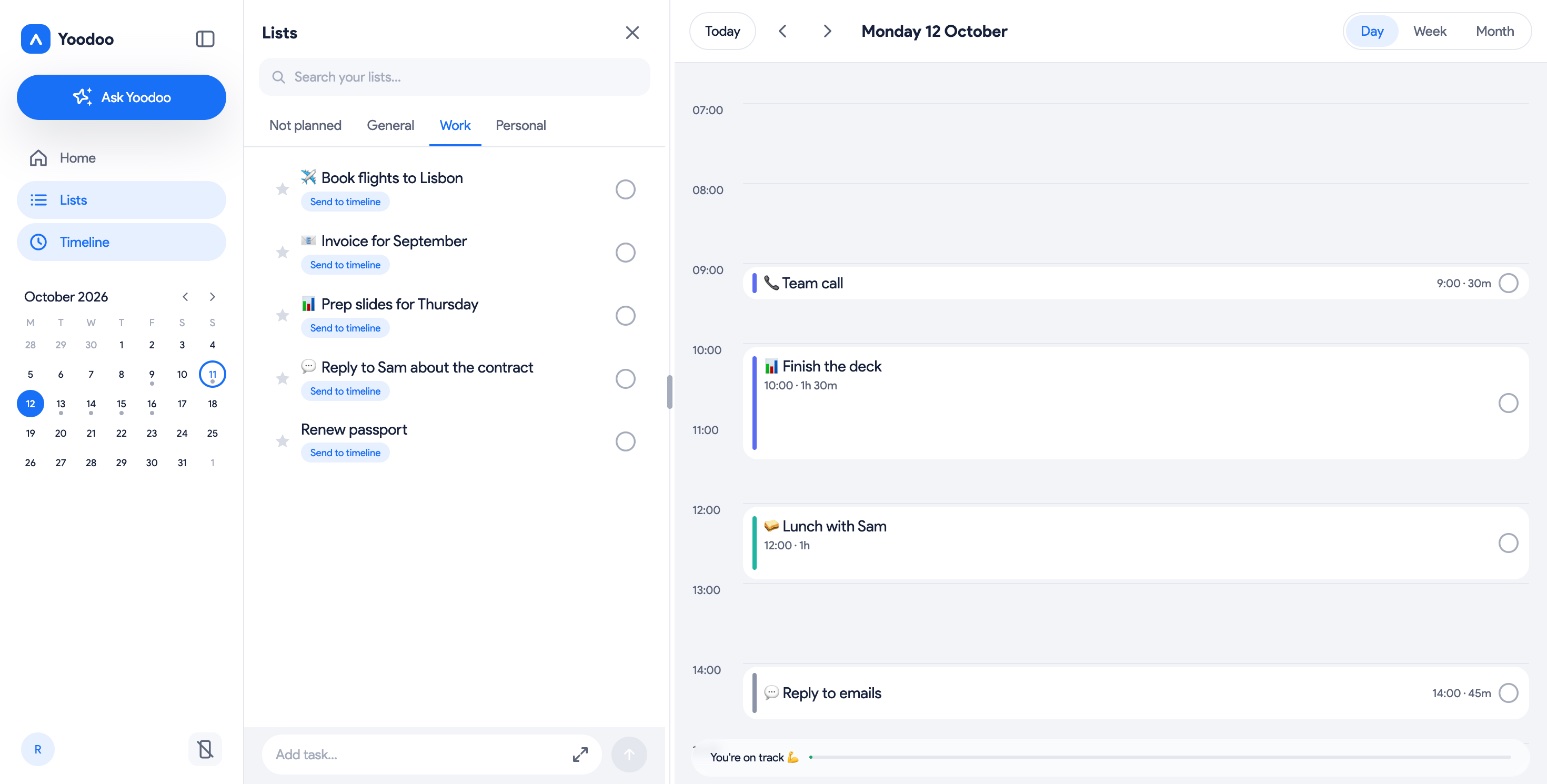
Plus hundreds of tiny things you'll only notice if they were missing. Missed tasks roll over instead of guilt-tripping you. Every delete has an undo. A light day never gets nagged. It works offline. It's fast. Like, properly fast.
"Not another planner app"
I know. I know.
There are thousands of planners and productivity apps out there. Every week there's a shiny new one with a slick launch video and more funding than I've had hot dinners. I've watched rivals with millions in the bank blow up and become huge, and I'd be lying if I said that didn't sting.
But none of them are like Yoodoo. None of them were built by someone whose own brain needed it. None of them were shaped by years of messages from people saying "this is the only one that works for me".
Look, I'm no marketer. We don't have millions of users or a billboard on the Tube. Most people find Yoodoo because a friend told them about it. But I'm determined to get it into the hands of every person who needs it most.
Why I didn't just walk away
Honestly? You.
I get hundreds of messages a year from people telling me Yoodoo changed their life. Some of them say it saved it. I'm not being dramatic, those are their words, and it still knocks me sideways every time. I read every single one.
You're the people I built this for. And somewhere along the way, you became the people who kept me building it.
That's why I'm still tweaking things at 1am. I use Yoodoo every day myself, and I'll keep making it better, for me and for you.
Massive thanks to my mates building their own products who kept dragging me back up, and to every single person who messaged me while Yoodoo was on hold. You're the reason it's back.
If you take one thing from this
Twenty careers. Four failed businesses. £80,000. A diagnosis I didn't want. A summer of being told no by half of London. One proper burnout.
And here I am, finally doing the thing I've dreamed about for years.
I'm not telling you that to show off. I'm telling you because if you've got ADHD, or your brain always feels three tabs ahead of your hands, I want you to hear this.
It's not over. Whatever your thing is.
ADHD is tough. I get it. It sucks. It properly sucks. Some days it feels like everyone else got the instruction manual and you got a leaflet in a language you don't speak.
But the right people around you, not taking no for an answer, and pushing, and pushing, and pushing again, will get you further than you'd ever believe. If I can do this, so can you.
So go and do the thing you've always dreamed of doing. And if Yoodoo helps you get there, even a little bit, then all of this was worth it.
Right. Your turn.
Download Yoodoo on iPhone or Android, or open it in your browser at app.yoodoo.app. You get all of Pro free for your first week, so go and break your day and let Yoodoo fix it.
And if it helps, tell me. You know I'll read it. Then tell a friend, because that's how almost everyone finds us.
Ross